

Une nouvelle approche de la restauration des surfaces dorées
Décors originaux retrouvés sur le Bargueno datant du XVIe siècle avec le laser Er :Yag et un processus de contrôle sous tomographie à cohérence optique. (OCT) | Publié le 07/02/2025

La restauration des surfaces dorées du meuble de voyage dit « le Bargueño », datant du XVIème siècle, provenant du Château de Pau, a été effectuée au sein de l’atelier dorure du C2RMF. L’étude préliminaire des zones de bois dorés et d’ivoires dorés effectuée par Stéphanie Courtier, restauratrice de bois dorés a permis de constater la présence de deux dorures. Il a été décidé avec la conservatrice Madame Pebay-Clottes, de dégager la dorure la plus moderne, permettant d’étudier et de mettre à jour les dorures et les décors d'origine.
Le dégagement de cette dorure moderne a été mis en œuvre avec un laser impulsionnel Erbium - YAG (Er: YAG) microseconde couplé à la tomographie en cohérence optique (OCT) - et a été accompagné d’analyses effectuées par les collègues du Département Recherche, notamment du Groupe Imagerie du C2RMF.
Des protocoles de dégagement laser et de contrôle OCT ont également été développés sur des éprouvettes représentatives afin de s’assurer de l’innocuité du traitement et de la conservation de l’intégrité des matériaux originels.
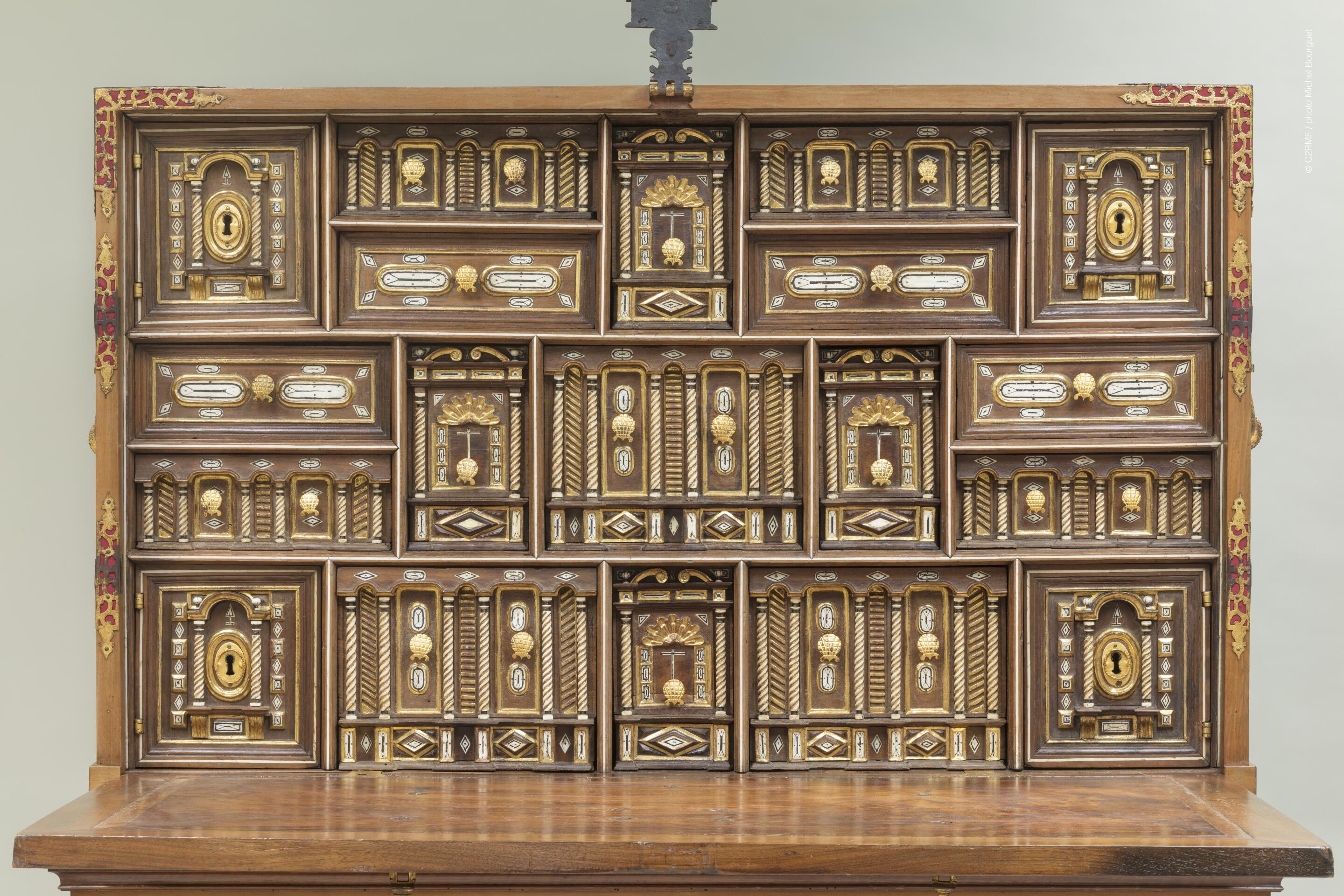
Le “Bargueño” a également était le sujet d’une publication d'article :
ABSTRACT
During the meticulous restoration of “the Bargueño,” an exquisite gilded travel cabinet dating back to the 16th century and hailing from the historic Château de Pau in France, an intricate conundrum surfaced. It was a puzzle involving the presence of two superimposed layers bonded by the same adhesive, a quandary insurmountable by conventional restoration techniques. The physical-chemical attributes of the materials posed a formidable challenge in the quest for an effective remediation strategy. Analysis revealed a duality in gilding techniques; the wooden portions were adorned with water gilding, while the ivory sections exhibited oil gilding. To address this exceptional restoration challenge, a groundbreaking method was embraced. A feasibility study was conducted employing a pulsed Er: YAG laser operating at 2940 nm in a µs regime, meticulously applied to gilded ivory prototypes. This laser methodology facilitated the precise ablation of layers, completely circumventing direct material contact. The degree of precision could be finely tuned by manipulating laser parameters. The laser ablation assessments on prototypes, varying in gilding layer thickness, were executed under the vigilant watch of optical coherent tomography (OCT). This innovative approach permitted the meticulous removal of layers during the restoration process of the ornate twisted and gilded columns, unequivocally affirming its efficacy in the preservation of gilded surfaces.
Le plan de sauvegarde des biens culturels

Département Conservation préventive

Département Archives et Bibliothèque
